
NVIDIA AI Infrastructure and Operations Fundamentals
Comprehensive guide to NVIDIA AI infrastructure covering GPU architecture, accelerated computing, training vs inference workloads, data center networking, storage design, virtualization, and operational best practices.

Syllabus:
1️⃣ Essential AI Knowledge (38%)
AI vs ML vs DL (AMDA)
AI
Machine simulating human intelligence and decision-making
- Example: Alexa, Siri, Self-driving car, Chatbot
Machine Learning (ML)
Ability of machine to learn without explicitly being programmed.
- Example: Spam detection, Fraud detection, Recommendation systems
Deep Learning (DL)
Ability of machines to process data in a way that is inspired by the human brain (by using artificial neural network)
- Focuses on utilizing multilayered neural networks to perform tasks such as classification, regression, and representation learning.
- Derives rules from the data itself, rather than relying on explicit programming.
- Example: Image recognition, Natural language processing, Speech recognition
Generative AI
Subset of DL that focuses on create new data that is similar to the data that was used to train the model.
- Example: ChatGPT, DALL-E, Stable Diffusion
AgenticAI
Subset of generative AI focused on autonomous decision-making and actions
- Example: Autonomous robots, AI agents, Self-driving cars
PhysicalAI
AI integrated with physical systems (IoT, robotics)
- Example: Smart home devices, Industrial automation, Autonomous drones
Relationship:
 AI
    |-- ML (Supervised, Unsupervised, Reinforcement)
         |-- DL (CNNs, RNNs, Transformers)
             |-- [Generative AI](https://developer.nvidia.com/topics/ai/generative-ai?sortBy=developer_learning_library%2Fsort%2Ffeatured_in.generative_ai%3Adesc%2Ctitle%3Aasc) (LLMs, Diffusion Models)
                    |-- Agentic AI (Autonomous systems, Robotics)
                              |-- Physical AI (IoT, Edge devices)
| Term | Key Idea | Exam Trap |
|---|---|---|
| AI | Machines simulating human intelligence | Broad umbrella |
| ML | Learns from data | Doesn’t require manual rules |
| DL | Neural networks, many layers | Subset of ML |
| GenAI | Generates new data | Subset of DL |
GPU vs CPU Architecture
| CPU | GPU |
|---|---|
| Few powerful cores | Thousands of smaller cores |
| Optimized for sequential tasks | Optimized for parallel workloads |
| Lower throughput | Massive parallel throughput |
| Best for control logic | Best for matrix operations |
Key Point: GPUs excel at matrix multiplications used in neural networks.
Training vs Inference
AI Workflow:
 Data Preperation
  |--> Model Training
     |--> Optimization
         |--> Inference/Deployment
| Training | Inference |
|---|---|
| Model learning | Model usage |
| High compute + memory | Lower latency focus |
| Batch workloads | Real-time workloads |
| Multi-GPU scaling | Edge + cloud deployment |
Training = compute intensive
Inference = latency optimized
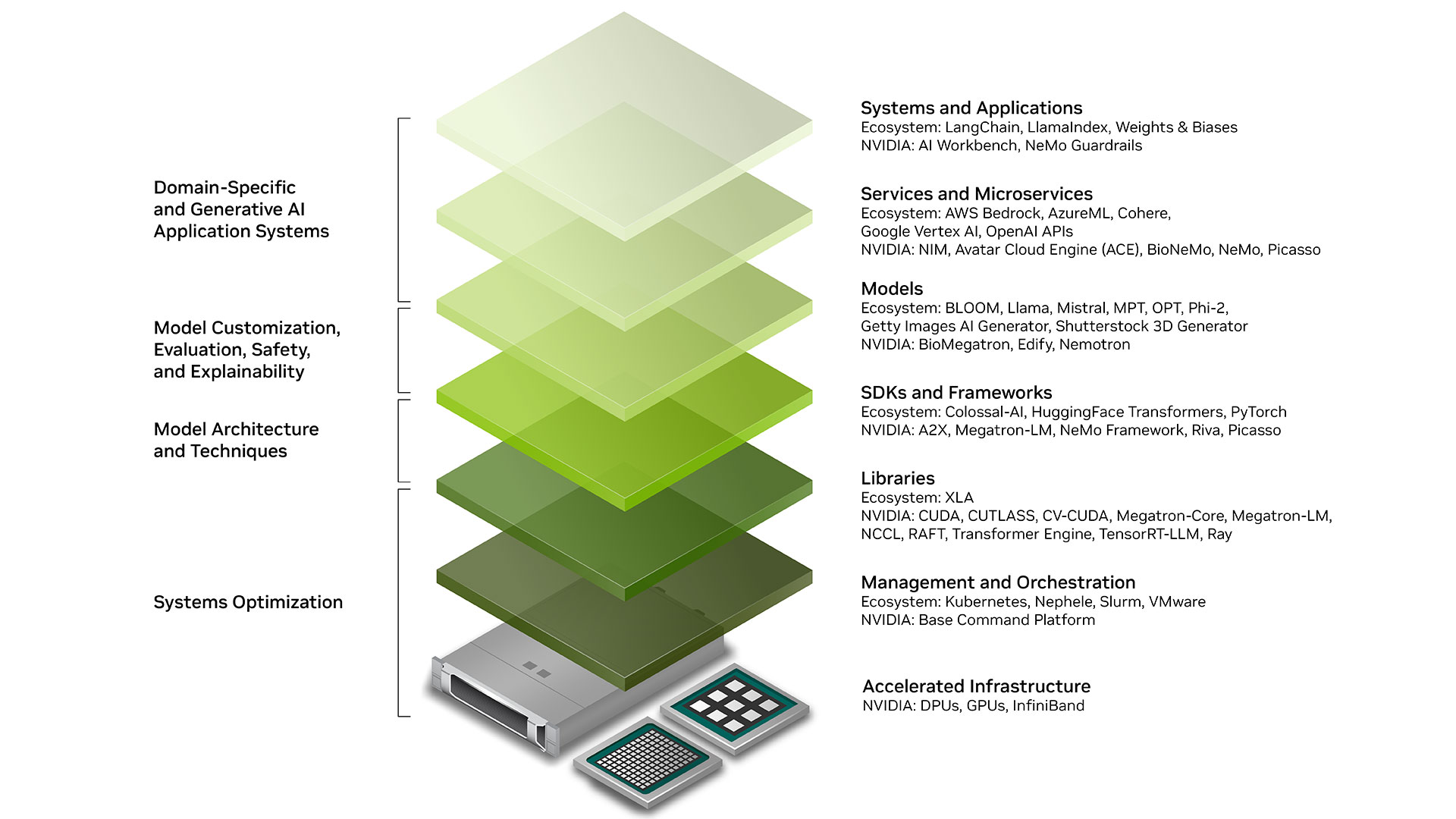
NVIDIA Software Stack (High-Level)
- CUDA → GPU programming platform
- cuDNN → Deep learning primitives
- TensorRT → Inference optimization
- NCCL → Multi-GPU communication
- RAPIDS → GPU data science
- NVIDIA AI Enterprise → Production AI platform
Why AI Adoption Accelerated
- GPU performance improvements
- Large datasets
- Cloud scalability
- Transformer architectures
- Pretrained models
- Open-source frameworks
2️⃣ AI Infrastructure (40%)
Scaling GPU Infrastructure
Scale-Up
- More GPUs per node
NVLinkNVSwitch
Scale-Out
- More nodes
InfiniBand- Ethernet
RDMA
Data Center Requirements
Power
- High rack density (30–80kW+ per rack)
Cooling
- Air cooling
- Liquid cooling
- Rear door heat exchangers
- Direct-to-chip cooling
Networking Requirements
Important concepts:
RDMARoCEInfiniBand- East-west traffic
- Spine-leaf architecture
High-speed DC options:
- 100G / 200G / 400G Ethernet
InfiniBand HDR/NDR
DPU (Data Processing Unit)
Purpose:
- Networking offload
- Security isolation
- Storage acceleration
- Free CPU resources
Architecture roles:
- CPU → General compute
- GPU → AI compute
- DPU → Infrastructure acceleration
On-Prem vs Cloud
| On-Prem | Cloud |
|---|---|
| CapEx | OpEx |
| Full control | Elastic scaling |
| Long-term cost efficiency | Fast deployment |
| Hardware management required | Managed infrastructure |
3️⃣ AI Operations (22%)
Monitoring GPUs
Key Metrics:
- GPU utilization
- Memory utilization
- Temperature
- Power usage
- ECC errors
- SM occupancy
Tools:
NVIDIA DCGM- Prometheus
- Grafana
- nvidia-smi
Cluster Orchestration
- Kubernetes
Slurm- Workload scheduling
- Job prioritization
- Multi-tenant isolation
Virtualization
- NVIDIA
vGPU MIG(Multi-Instance GPU)- GPU partitioning
- Isolation vs performance trade-offs